
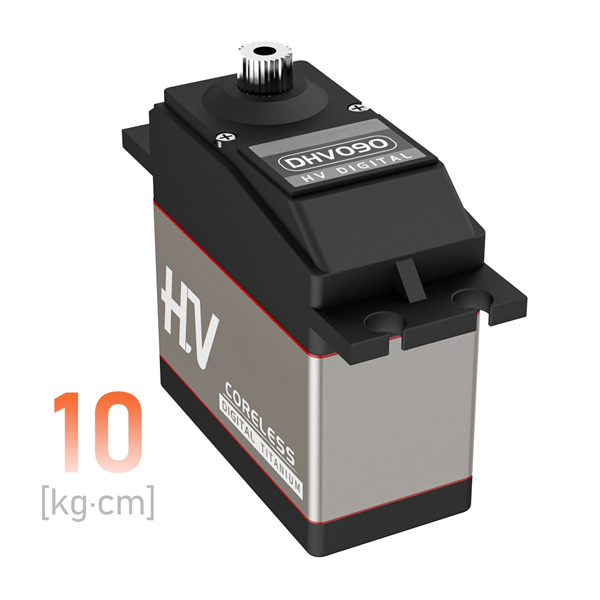
TL;DR: A coreless servo is the right choice when your application demands sub-0.10s/60° response and you can keep duty cycle below ~50%. Match four specs to the job: response time, dead band, cogging torque, and no-load current. For continuous-load robotics or crawlers under sustained binding torque, a brushless servo is usually the smarter premium upgrade. Below: the framework, a six-application decision matrix, and the three mistakes buyers keep making.
1. Coreless, Cored, or Brushless? Solving the Confusion First
A coreless servo and a brushless servo are not the same thing. Conflating them is the most common mistake at this price tier, and it’s the one I’d rant about first if you cornered me at a track.
A coreless motor is still a brushed DC motor. The difference is the rotor: instead of copper windings wrapped around a laminated iron core, the windings are self-supporting (a “skew-wound” or “honeycomb” copper basket) with no iron in the rotor at all. Maxon’s ironless designs achieve roughly 10× lower rotor inertia than equivalent iron-core motors, with effectively zero cogging torque because there are no iron teeth for the magnets to attract [Source: maxongroup.com/dc-motor-technology].
A brushless motor uses electronic commutation. The rotor is typically a permanent magnet, the windings live in the stator, and there’s no mechanical commutator to wear out. Brushless motors can have iron-core or ironless stators, so “brushless” and “coreless” describe different axes entirely. You can have a brushless coreless motor. You can have a brushed coreless motor. The two words aren’t synonyms and they aren’t opposites.
A standard cored servo uses a brushed motor with an iron-core rotor. Heavier rotor, measurable cogging, more torque ripple, slower response. But cheap and durable, which is why most of what you’ve owned in your life is cored.
| Characteristic | Cored (brushed) | Coreless (brushed, ironless) | Brushless |
|---|---|---|---|
| Rotor inertia | Highest | Lowest (~10× less than cored, per Maxon) | Low to medium |
| Cogging torque | 1–5% of rated torque (typical range, varies by topology) | Effectively zero | Low (varies; ironless brushless ≈ 0) |
| Response time @ 60° | 0.12–0.20 s typical | 0.06–0.10 s typical | 0.05–0.10 s typical |
| Lifespan (limiter) | Brush wear, gear wear | Brush wear (faster than cored — thinner brushes) | Bearing/gear wear; no brushes |
| Price band (hobby) | $20–$60 | $60–$150 | $130–$250+ |
| Heat tolerance under sustained load | Highest thermal mass | Lowest thermal mass | Highest (no brush losses) |
Coreless servos sit between cored and brushless. You get response speed and smoothness without the full price of brushless, but you inherit the brushed motor’s wear life and have less thermal mass than either alternative. That last point catches people.
<!– Sources for this section: 1. https://www.maxongroup.com/medias/sys_master/root/8821506539550/DC-Motor-Technology-Short.pdf 2. https://www.portescap.com/en/newsroom/whitepapers/2020/03/brushless-dc-vs-coreless-dc 3. https://www.motioncontroltips.com/faq-what-is-cogging-torque-in-electric-motors/ –>
2. The Four Specs That Actually Decide Your Purchase
Four specs determine coreless servo performance: response time (seconds per 60° at load), dead band (microseconds), cogging torque, and no-load current. Headline torque (kg·cm) tells you almost nothing about whether the servo will feel right in your application.
Response time (s/60°). Manufacturers usually quote no-load speed at maximum voltage. The number that matters is the loaded figure. Most coreless racing servos publish 0.06–0.08 s/60° at 7.4V. The KST X20-2208 lists 0.075 s/60° at 8.4V; the ProTek 170T lists 0.07 s/60° at 7.4V [Source: kstservo.com/x20-2208, protekrc.com/170t]. Below 0.10 s/60° is where coreless starts being worth its premium for racing or fast-correcting flight surfaces.
Dead band (µs). The smallest pulse-width change the servo will respond to. Standard hobby servos sit at 4–8 µs. High-end coreless servos publish 1–3 µs (the KST X20-2208 lists ±1 µs). For robotics or scale steering at low speeds, a tight dead band is what makes micro-corrections feel smooth instead of stair-stepped.
Cogging torque (mNm). The torque needed to rotate the motor by hand with no power applied, caused by magnet-to-iron-tooth attraction. Iron-core motors typically show cogging at 1–5% of rated torque. Coreless motors have zero cogging by design — there’s no iron rotor for the magnets to grab. This is the single biggest reason coreless servos hold position cleanly under tiny corrections, and it’s why I default to coreless for any precision-pointing job under intermittent load.
No-load current (mA). How much current the servo draws while idling at neutral. A coreless servo with a tight loop and no cogging can sit at 8–15 mA idle. A cored servo with cogging plus a sloppy loop may sit at 50–100 mA. Multiply by the number of servos in a humanoid robot or multirotor and idle current decides battery life.
3. Matching Servo Class to Application — A Decision Matrix
| Application | Min. torque @ voltage | Response time threshold | Gear material | Coreless or brushless? |
|---|---|---|---|---|
| 1/10 on-road touring car | 7–10 kg·cm @ 6.0V | ≤0.08 s/60° | Steel or titanium | Coreless is the sweet spot |
| 1/8 buggy / monster truck | 20–30 kg·cm @ 7.4V | ≤0.10 s/60° | Steel | Coreless OK; brushless if budget allows |
| Crawler (high holding torque, low speed) | 25–40 kg·cm @ 7.4V | ≤0.15 s/60° (speed irrelevant) | Steel (shock tolerance) | Brushless. Sustained binding torque cooks coreless. |
| Sub-250g drone gimbal / FPV | 1.5–3 kg·cm @ 6.0V | ≤0.06 s/60° | Aluminum or plastic OK (low load) | Coreless; weight-critical |
| Humanoid robot joint (wrist/elbow) | 8–15 kg·cm @ 7.4V | ≤0.10 s/60° | Steel or titanium | Coreless workable; brushless better for shoulder/hip |
| Robotic arm with payload | Depends on arm length × payload (see below) | ≤0.10 s/60° | Steel | Brushless or industrial-grade only |
For humanoid robotics, hobby-grade coreless servos run out of headroom fast. Unitree’s G1 humanoid uses joint actuators rated for roughly 120 Nm peak at the hip [Source: unitree.com/g1] — orders of magnitude beyond what a 25 kg·cm coreless hobby servo (≈2.5 Nm) delivers. Hobby coreless is fine for a wrist or gripper. Load-bearing joints want a different category entirely.
Robotic arm payload-to-torque rule of thumb: required joint torque (kg·cm) ≈ payload (kg) × arm-length-from-joint (cm) × safety factor of 2–3. A 200 g gripper at 30 cm reach needs ~12–18 kg·cm at the shoulder joint just to hold position. Ignore acceleration and you’ll stall under motion.
<!– Sources for this section: 1. https://www.kstservo.com/en/product/X20-2208 2. https://www.protekrc.com/170t-low-profile-high-torque-high-speed-coreless-servo 3. https://www.unitree.com/g1 4. Reddit r/rccars and r/robotics discussions, 2024-2025 –>
4. Reading the Datasheet Like an Engineer (Including the Numbers Manufacturers Hide)
Most servo datasheets are written to flatter the headline number.
| What the datasheet says | What it actually means |
|---|---|
| “Torque: 25 kg·cm @ 8.4V” | Stall torque at maximum voltage. Running torque is typically 60–70% of stall. At 6.0V, the same servo may produce 18–20 kg·cm. |
| “Speed: 0.07 s/60°” | Almost always no-load speed at max voltage. Loaded speed at half-stall is 30–50% slower. |
| “Operating voltage: 6.0V–8.4V” | Specs (torque, speed) usually listed only at the top voltage. Derate accordingly for 6.0V BEC use. |
| “Dead band: ±1 µs” | This is genuinely a top-tier number. Trust it more than torque claims. |
| “Coreless motor with metal gears” | “Metal” is undefined. Could be steel, titanium, or a steel/aluminum mix. Ask which gears are which. |
| (No duty-cycle spec listed) | The biggest tell. A servo with no duty-cycle rating is implicitly designed for intermittent use only. |
What’s commonly missing on hobby datasheets:
- Continuous-duty current — only stall current shows up
- Cogging torque — rarely quoted, complicates marketing
- Bearing type, often just “dual ball bearings” without sizes or material
- MTBF or expected operating hours
- Temperature rating of internal electronics
- Return-to-center accuracy under repeated cycling
Cross-reference any datasheet against forum teardowns on RCGroups or RCTech before trusting it. Manufacturers in this category have been known to update internal components without changing the SKU, anecdotally — this is a pattern reported across multiple forum threads, not something I can point you at a single canonical source for.
5. Thermal Reality — Why Coreless Servos Run Hot and What to Do
Coreless servos run hotter than cored servos under continuous load because their lighter rotors store less heat, and because their thinner brushes tolerate less I²R loss before degradation accelerates. This is the part that catches most buyers, and it’s where I personally cooked my first coreless servo (1/10 crawler, didn’t read the fine print, stalled it on a ledge for maybe 15 seconds, dead).
A standard cored rotor acts as a thermal flywheel. Under a 2-second stall, the iron mass absorbs the heat pulse and dissipates it slowly through the case. A coreless rotor has no iron mass — the heat pulse goes straight into the windings and brushes. A 30 kg·cm coreless servo holding a crawler against a rock for 10 seconds can hit internal temperatures that no cored servo of equivalent torque would reach in the same scenario, based on aggregated user reports from r/rccars.
Practical duty-cycle derating:
Continuous-duty torque ≈ rated stall torque × 0.30–0.40
If you need to hold 12 kg·cm continuously, buy a servo rated 30–40 kg·cm stall. Hitec and similar manufacturers have published 30% duty-cycle guidance for performance servos under stall conditions [Source: hitec-multiplex.com/support].
Cooling strategies that actually help:
- Aluminum-bodied middle case acts as a heatsink, not just cosmetic
- Airflow over the case (passive convection inside an RC chassis is poor)
- External heatsink fins or a small thermal pad bonded to the case for high-cycle applications
- Reduced loop tension. A lot of crawler users report failures that trace back to mechanical binding, not the servo itself
- Voltage backoff. Running 6.0V instead of 8.4V reduces internal heating roughly 30–40%, based on I²R scaling math rather than a single cited measurement
If your application demands continuous holding torque (crawler ledges, robotic arms holding pose, gimbal under wind load), brushless is the correct upgrade. Not a higher-torque coreless.
<!– Sources for this section: 1. https://hitec-multiplex.com/support/ servo thermal management 2. Reddit r/rccars crawler thermal failure threads, 2024-2025 3. https://www.maxongroup.com/medias/sys_master/root/8821506539550/DC-Motor-Technology-Short.pdf –>
6. HV (High Voltage) Operation — When 7.4V or 8.4V Is Worth It
Running a coreless servo on a 2S LiPo (8.4V fully charged) instead of a 6.0V BEC delivers measurable torque and speed gains. KST, Savox, and ProTek all publish dual specs, and typical patterns show roughly +25–35% torque and +15–25% speed at 8.4V vs 6.0V [Source: KST X20-2208 datasheet, ProTek 170T product listing]. The ProTek 170T, for example, is marketed as a 7.4V servo. Its torque and speed numbers at 6.0V are notably lower.
The cost side:
- Heat output scales roughly with V² for the same load (basic I²R reasoning). Higher voltage means hotter windings.
- Brushes wear faster at higher voltage and current.
- Internal MOSFETs and capacitors must be rated for the higher rail.
- Your BEC or ESC has to supply a clean 7.4V/8.4V. Not all do.
Use HV when:
- You need the speed/torque gain and can manage the thermal cost (1/8 race buggy, fast aerobatic plane)
- You’re running directly off a 2S LiPo and the servo is rated for HV
- The application is intermittent: racing, flight, not continuous holding
Skip HV when:
- Crawler with sustained holding load. Heat will dominate.
- Servo not explicitly HV-rated. Running 8.4V into a 6.0V-only servo destroys the electronics.
- Battery life matters more than the last 20% of performance.
There are no published independent lifespan studies comparing 6.0V vs 8.4V operation on identical coreless servos that I’ve been able to find — extensive search returned only manufacturer marketing and forum anecdote. Treat the lifespan claim as plausible but unquantified.
7. Build Quality Tells — Gears, Bearings, Cases
| Feature | What It Predicts |
|---|---|
| Steel gears | Best shock tolerance. Heavier. First-choice for crawlers, monster trucks, anything with impact loads. Can deform under extreme overload but rarely shatters. |
| Titanium gears | Lighter than steel, harder than aluminum. Excellent for racing where weight matters. Failure mode is shear under sudden impact rather than gradual wear. Premium price tag. |
| Aluminum gears | Light, cheap, only suitable for low-torque applications. Strip easily. Avoid in any servo handling more than ~10 kg·cm sustained load. |
| Dual ball bearings (output shaft) | Significantly better than bushing + bearing. Reduces shaft wobble, directly improves dead-band performance over time. Standard on any servo above ~$80. |
| Aluminum middle case | Not just cosmetic. The middle case is where the motor sits. Aluminum acts as a heatsink. Plastic middle cases on coreless servos are a thermal red flag. |
| Full-aluminum case | Even better thermal performance, adds weight. Common on high-end servos (Savox SB-2290SG, MKS HBL series). |
| IPX rating | Read carefully. IPX5/IPX6 is splash-resistant only. IPX7 is temporary submersion. Most “waterproof” hobby servos are splash-rated, and the case seal often fails after the first gear-strip repair when the case is reopened [Source: rccaraction waterproof servo testing]. |
Gear failure modes worth knowing:
- Steel gears in high-shock applications (rock crawlers, monster truck landings) tend to deform a single tooth before complete failure. You get audible warning.
- Titanium gears tend to shear cleanly under impact. No warning, immediate failure.
- Aluminum gears in over-torque conditions strip multiple teeth at once.
Crash hard and frequently: steel. Race and shave grams: titanium. Neither: aluminum is acceptable but only on low-torque servos.
8. The Three Mistakes Buyers Make
Mistake 1: Buying on torque headline alone
Why it happens: torque is the easiest spec to compare. Two numbers, bigger wins. Marketing reinforces it.
The fix: use the four-spec framework from Section 2. If the servo lacks a published dead-band number, treat it as ≥5 µs. If response time is quoted only at no-load, assume loaded speed is 40% slower. Two servos within 20% torque of each other but with 3× difference in dead band are not the same servo, and they will not feel the same on the bench.
Mistake 2: Underestimating thermal load in continuous-duty applications
Why it happens: datasheets quote stall torque, not continuous-duty torque. Buyers size for peak demand and discover the thermal limit only after a meltdown.
The fix: apply the 30–40% derating rule from Section 5. If you need 12 kg·cm continuous, buy 30+ kg·cm stall. If your application involves sustained binding load — crawler ledges, robotic arm holding pose, gimbal fighting wind — skip coreless entirely and buy brushless. If your servo will hold non-zero torque for more than 5 seconds at a time, derate to 30% of stall.
Mistake 3: Paying for coreless when brushless is the better upgrade
Why it happens: coreless is the visible “premium” tier on most hobby retail pages. Brushless servos sit a price tier higher and get less marketing exposure. Buyers upgrade one rung when they should upgrade two.
The fix: compare on cost per useful hour, not cost per servo. A $90 coreless that fails after 200 hours of crawler abuse costs more per hour than a $180 brushless running 800+ hours in the same application. For continuous-duty, high-cycle, or precision-robotics work, the brushless premium pays back. If duty cycle exceeds 50% or expected operating life exceeds 500 hours, price-compare against brushless before defaulting to coreless.
I’ll admit I still spec coreless for my own touring car even when a brushless would be technically defensible at the price point — partly habit, partly because I trust the KST product line specifically and don’t want to relearn a new brand’s quirks. That’s not a justification, that’s a bias. Worth naming.
Frequently Asked Questions
Are coreless servos worth the extra money?
Coreless servos earn the premium when your application needs response time below 0.10 s/60° and dead band tighter than 3 µs. That’s typically 1/10 racing, fast aerobatic flight, or precision wrist/gripper joints. For crawlers, continuous-load robotics, or casual bashing, the money is better spent on a brushless servo or a quality cored one. Don’t pay for performance characteristics you can’t use — a 1 µs dead band on a basher truck is wasted money, and the thinner brushes will shorten your servo’s life under abuse you wouldn’t have inflicted on a cored unit. Buy for the duty cycle you actually run, not the one on the box art.
What’s the difference between coreless and brushless servos?
A coreless servo is still a brushed motor with an ironless rotor. A brushless servo replaces the brushes with electronic commutation. Coreless wins on price and weight. Brushless wins on lifespan and continuous-duty thermal headroom.
Do coreless servos overheat under continuous load?
Yeah, basically. Size them for 30–40% of rated stall torque when load is continuous rather than intermittent.
How long do coreless servos last compared to standard servos?
Independent MTBF data is scarce, but the wear-limiting parts are similar: brushes and gears. Coreless brushes are typically thinner and wear faster than cored brushes under equivalent load. In hobby use, expect 200–600 hours of active operation before brush or gear service. Significantly less than brushless servos, which can run 1000+ hours under similar conditions.
Source Links:
1. https://www.savoxusa.com/products/savsb2290sg
2. https://www.mks-servo.com.tw/products/HBL series
3. RCGroups gear material discussion threads
4. https://www.rccaraction.com/
About the Author
Written by Robin Luo: an engineer with 10+ years of hands-on experience in RC racing, FPV drone building, and humanoid robotics actuator selection. Has personally burned out coreless servos in crawlers, raced 1/10 touring at the regional level, and specified servos for university-grade biped projects. Opinions here come from broken hardware, not press releases.